
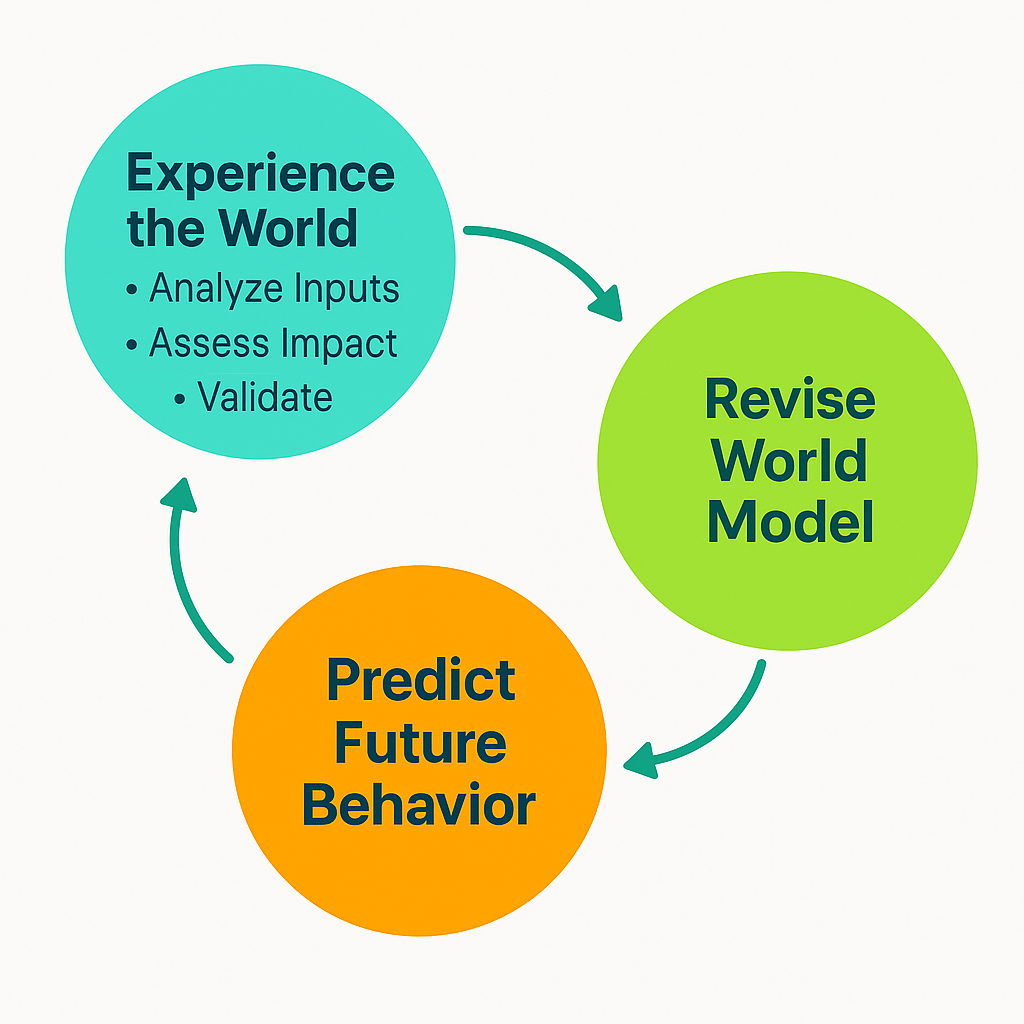
This is only one of many different models of how humans learn.
People perceive the world through a rich interplay of sensory inputs—sight, sound, taste, smell, touch—and internal biochemical signals that give rise to emotion. Each new encounter is filtered through our existing mental model, which we then update: sometimes tweaking a previously held belief, sometimes adding entirely new insights. From this evolving model we generate expectations or predictions, which in turn guide our thoughts and actions. Every subsequent experience either confirms those predictions, challenges them, or surprises us altogether—fueling an ongoing cycle of learning and adaptation.
Applying this sensory-model-prediction framework to a Large Language Model (LLM) offers a useful way to understand how these systems “learn” and adapt—especially once you see that at their core, they are very large neural networks whose billions of interconnected parameters encode and update an internal world model.
-
Tokens as “Sensory Inputs” and Embeddings
The model only “sees” text—words, punctuation, even single letters. It turns each of these into numbers so it can work with them.
DETAILS: Just as humans take input from their senses, an LLM “senses” only text-based input: raw tokens—words, punctuation, even characters. These symbols are mapped into high-dimensional embeddings by the input layer. Each dimension of that vector represents some latent feature of meaning, allowing the network to treat language as a continuous pattern.
-
Neural Network Architecture: Layers and Activations
Built as a neural network, the model has many stacked layers. Each layer refines what came before, gradually turning raw text into more meaningful patterns.
DETAILS: An LLM is built from stacks of neural layers—each containing many artificial “neurons.” A neuron computes a weighted sum of its inputs, applies a non-linear activation (e.g. GELU), and passes the result onward. Through successive layers, the network builds hierarchical features: lower layers capture syntax, while higher layers encode semantics such as topic or intent.
-
Transformers and Self-Attention as Integration Mechanisms
At each step, the model looks at all the words it’s seen so far and decides which ones are most important for predicting the next word.
DETAILS: The transformer architecture uses self-attention modules. In each attention block, every token’s embedding attends to all others in the current context, computing attention scores via learned projection matrices. This dynamically integrates contextual cues, highlighting which tokens most inform the next-token prediction.
-
Training: Prediction, Error, and Back-Propagation
During training, it reads billions of sentences, guesses the next word each time, and then checks if it was right. When it’s wrong, it adjusts its layers a bit so it’s more likely to guess correctly next time.
DETAILS: For each of the billions of sentences, it makes a next-token prediction and compares it to the true token, yielding an error. Back-propagation then adjusts each weight via gradient descent, gradually sculpting the parameter landscape to capture statistical regularities of language.
-
Inference: Generating Text via Probabilistic Expectations
When you give it a prompt, it runs through its layers and attention steps to score each possible next word, then picks (or samples) one and repeats until you have your output.
DETAILS: At inference, input embeddings flow through the network to produce next-token probability distributions. Sampling or selecting the highest-probability token yields generated text, which is then fed back in to continue the sequence.
-
Continual Learning: Fine-Tuning and Human Feedback
You can “teach” it new styles or facts by giving it more examples or by signaling which answers you prefer. It then practices on that feedback, tweaking itself to perform better on those tasks.
DETAILS: Fine-tuning on domain-specific data or using reinforcement learning from human feedback exposes the same network to new “experiences,” with further rounds of back-propagation refining its parameters to align with specialized tasks or user preferences.
By viewing an LLM as a giant, layered neural network, you can see exactly how “sense, model, predict, act, and learn” maps onto the concrete mechanics of LLMs. Just as richer sensory experiences and clearer feedback help humans refine their understanding, more diverse training data and high-quality feedback loops help neural networks internalize more accurate models of language across diverse domains.
Think of an LLM as an unfathomably vast web of language-based knowledge—billions of words and ideas all linked together in countless ways. Our challenge is to use AI as a guide, charting the most relevant path through those interconnections to discover the answers we need.